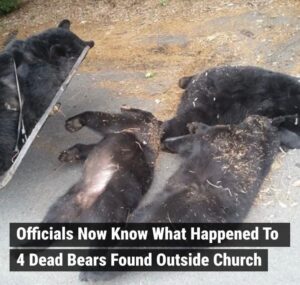
The cause of death of multiple bears that were discovered in a Pennsylvania church parking lot has been revealed.
The West Wyoming Borough Police Department was called to St. Monica’s Parish to investigate the discovery of three dead bear cubs and their nearly 300-pound mother, the department said in a Facebook post.The department called in the Pennsylvania Game Commission and the animal’s deaths were labeled as suspicious.
The commission asked the public for help via Facebook to find out what happened to the bears.
There were no “signs of bullet wounds or external trauma” to the animals.
“We consider the deaths of these bears highly suspicious,” Game Commission Northeast Region Law Enforcement Supervisor Mark Rutkowski said. “Toxicological testing will be performed in an attempt to determine a cause of death.”
The Pennsylvania Game Commission revealed on Facebook the bears likely cause of death: poisoning.
The four bears were found dead in or around the same tree without “evidence of thrashing or stumbling in the area…suggesting they died suddenly.”
The mother bear and a cub were given a post-mortem examination and toxicological testing at the Penn State Animal Diagnostic Laboratory in State College.
By examining their stomach contents, it was discovered they had recently consumed leaves and seeds of an English yew (Taxus baccata) plant.
The English yew is a plant with lance-shaped leaves and produces a “red berry-like cupped structure called an ‘aril’ that contains a single brown seed. It is widely cultivated in eastern North America as an ornamental shrub and often found in urban environments.”
Every species of yew contains the alkaloid compound taxine, which is toxic to most animals and humans if ingested, the commission said. In the winter months, the toxicity level of the yew increases, and is cardiotoxic, which impacts the heart’s ability to beat properly.
“Organic chemical screens were performed on the stomach contents, liver and kidneys of the bears to test for the presence of pesticides, euthanasia agents and environmental contaminants. The results of these screens, as well as a tests for the presence of ethylene glycol (a compound found in antifreeze) were all negative,” the department wrote on Facebook.
Therefore, the presence of the leaves and seeds in the stomach of the bears led to the conclusion that their deaths were from plant toxin poisoning.